Article 11: On Ecumenical Unity
The Rt. Rev. Winfield Mott
Article 11
“We are committed to the unity of all those who know and love Christ and to building authentic ecumenical relationships. We recognize the orders and jurisdictions of those Anglicans who uphold orthodox faith and practice and we encourage them to join us in this declaration.”
Confessional documents are contemporary applications of the unchanging Gospel message. Article 11 restates the prayer of Jesus in John 17:21, “that all of them may be one, Father, just as you are in me and I am in you.” To commit to Christian unity is to align ourselves with the will of Jesus, expressed in his prayer. Praying, “Thy will be done,” includes Christian unity. Failure to achieve that unity is, in a word, sin.
The Christian community is described in the New Testament, especially by Paul, by the analogy of the body, each part having a place and function, but all united in one body, with the head in charge. “We are very members incorporate in the mystical body of thy Son, which is the blessed company of all faithful people,” in the eloquent Prayer Book words.1 If that Body is wounded or amputated, unity has failed.
Some conceive of ecumenism primarily in terms of institutional merger. But Jesus places it in the context of the relationship between the Father and the Son, a seamless unity bonded by perfect love. In contrast, the Canterbury Communion’s “Instruments of Unity,” driven by institutional connections, bonded by money, are unable to achieve the goal of Jesus’ prayer. “Let us love one another, that we may with one mind confess the Father, Son and Holy Spirit” is the way the Liturgy of St. John Chrysostom introduces the congregation’s confession of the Nicene Creed. True unity is motivated by divinely-modeled and divinely-inspired love and expressed in a shared Faith.
How does this play out in doing faithful ecumenism?
Our Baptismal Unity
The source of all ecumenical life is Trinitarian baptism. The mandate given by Jesus in his last message to the apostles was to go baptize all people, teaching them to be disciples (Matthew 28:18-20). It is baptism which incorporates us into the Christian family, granting us union with God and one another in Christ. Baptism is also foundational because it is God’s act, not man’s. The Christian community is not achieved by man’s efforts, but through the reception of sacramental grace from God. We “know and love Christ” because he first loved us.
The great Danish theologian, Bishop Nicholai Grundtvig, notes that the Creed comes alive only when being confessed by the congregation, the gathered and living Faithful. What God has done through Baptism is not merely to unite an individual to Christ, but to make an individual a member of Christ’s Church. Union between God and Man at the individual level overflows into the corporate. Thus, what began with the Baptismal Symbol of the Apostles’ Creed expands into the Eucharistic Symbol of the Nicene. The living confession of the Creed is a united witness shared by all the Faithful, loving one another in creedal harmony. Ecumenism does not thrive as much in interdenominational negotiations as it does in the shared unity of prayer and praise with the ultimate telos of full Eucharistic participation.
Two-Tiered Ecumenism?
The days when denominational loyalty meant a shared belief are gone. Virtually all major denominations are now divided, with each group not acknowledging the validity of others within the same denomination. The repositioning, sad as it is, does mean orthodox Christians increasingly find each other beyond institutional identification. Knowing and loving Christ is not limited to one denomination, for our Baptisms transcend these institutions.
Article 11 distinguishes between orthodox Anglicans and other Christians. The former are invited to join in signing the Jerusalem Declaration. This would seem to invite a two-tiered ecumenism, one for Anglicans and one for others. But orthodox Christians are not fundamentally divided when it comes to the core deposit of the faith. While theological distinctions often remain among the orthodox, more often cultures rather than institutions are dividing lines. Archbishop Jeffrey Fisher pointed out some time ago that to be Anglican is simply to be a catholic Christian. And for all orthodox Christians we invite them to pray with us and join us in the mere catholicity expressed in the Chicago-Lambeth Quadrillateral.
Innovation Inhibits Integrity
Jesus laments over Jerusalem, “How often I have longed to gather your children together, as a hen gathers her chicks under her wings, but you were not willing!” (Luke 13:34). We assume all within the “blessed company of all faithful people” are baptized believers by definition. Those not faithful to the Gospel message, we assume are not in the “blessed company.” The seriousness and tragedy of our divisions is real and must be acknowledged.
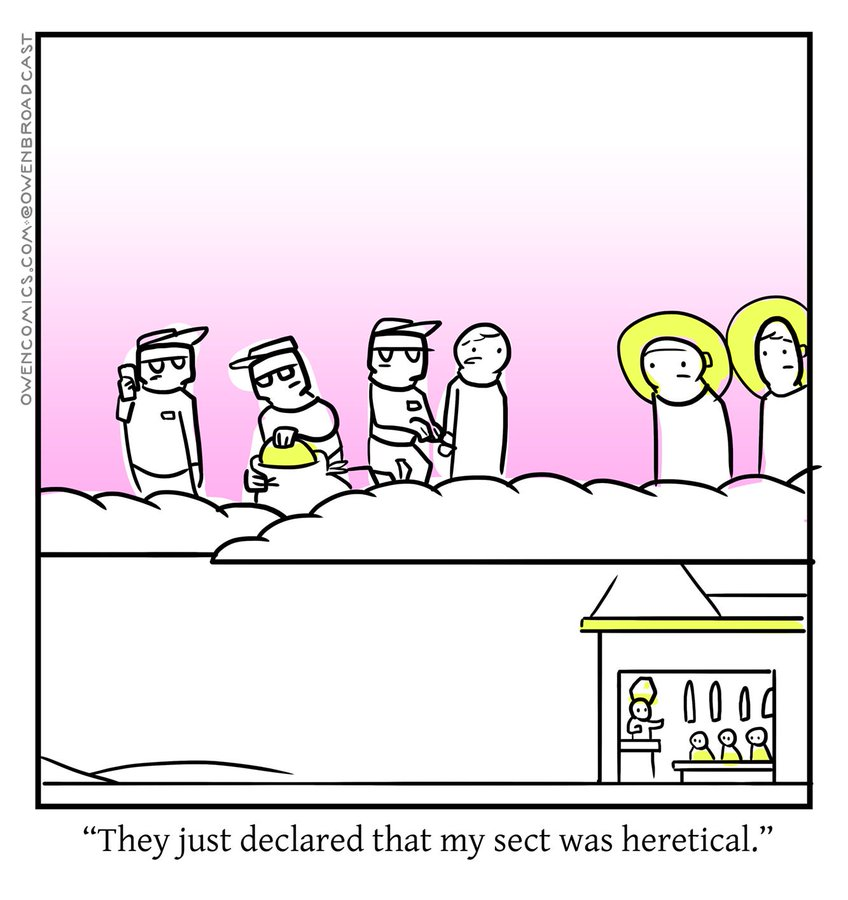
Those who have long commanded the core institutions of Anglicanism are wont to cry “schism” at orthodox Anglicans who remain faithful to the Gospel message, and thus cannot share in the theological distortions promulgated by these institutions. Such accusations of schism, however, are based on cultural, not theological bonds. Schism is departure from the Body of Christ, as witnessed by the authority of Scripture passed forward through the catholic Tradition. The burden of proof is on those who adhere to novel doctrines to show how they remain within the Body of Christ.
Sadly, Christians continue to be divided and Jesus continues to weep over Jerusalem. Article 11 and Article 13 express opposites which must be seen in tandem, the one confessing “the unity of all who know and love Christ,” the other pronouncing anathema on those who stand outside the orthodox Faith. Our Eucharistic joy in the Body is mitigated by our sinful disunity which tears it apart. In particular, the neology to which many cling, even within GAFCON itself, continues to devastate the unity of the Faithful. To be catholic, as most Anglicans self-identify, is to be driven by the ecumenical mandate. Ecumenical and catholic are even congruent words, the one speaking of the Church as a family household, the other of belonging to the wholeness of the Church.
Unity Is Not Optional
Christian unity is not an optional extra or marginal activity; it is the will of God. As such, we must respond with sincere, clear action. Let us pray, with Jesus, that we may be one, and cooperate with the Spirit to make it happen. Let us continue to seek the mind of Christ together, that our sad divisions may cease, not because we ceased to care about doctrinal clarity, but because the Spirit has led us into all the truth. Let us worship, as God enables, with orthodox Christians, recognizing that it is through our adoration of the Father through the Son in the Spirit that we receive unity.
-
Second Post Communion Prayer, BCP 1662 ↩︎