Article 12. On God-given Diversity and Freedom in Secondary Matters
By The Rev. Canon Jay Thomas
Article Twelve
We celebrate the God-given diversity among us which enriches our global fellowship, and we acknowledge freedom in secondary matters. We pledge to work together to seek the mind of Christ on issues that divide us.
In Article 11, the Jerusalem Declaration looks with two separate gazes at the whole of Christ’s Church. From one perspective it considers the fundamental unity which binds together “all those who know and love Christ,” offering an open-handed ecumenism toward those outside of the Anglican Communion. Its other perspective considers those within the Anglican family, stating that it “recognises the orders and jurisdiction of those Anglicans who uphold orthodox faith and practice and we encourage them to join us in this declaration.” 1 To understand Article 12, we must understand the logic of Article 11. Within Article 12 the first-person-plural pronouns (we, us) refer not to the entire Body of Christ (to whom we extend the open hand of gospel ecumenism), but rather to those Anglicans “who uphold orthodox faith and practice.” It is only within the “us” of orthodox Anglicanism that we can understand the bounds of the diversity that we claim to celebrate, as well as establishing the markers of what is a primary or a secondary matter.
A Three-Fold Hierarchy of Issues
The principle of adiaphora has long been recognized within the Church. For this reason, within the Global Anglican Communion, “we celebrate the God-given diversity among us…and acknowledge freedom in secondary matters.” 2 Or, as St. Paul wrote to the Colossians, “Let no one pass judgment on you in questions of food and drink, or with regard to a festival or a new moon or a Sabbath. These are a shadow of the things to come, but the substance belongs to Christ” (Colossians 2:16-17). As such, there are a multitude of issues within our Global Anglican Communion—festivals, ceremonial, customs—which merely partake of the “shadow of things to come” and in these matters there is great freedom and a beautiful diversity.
Yet Paul does believe that there are matters in which judgment may and indeed must be passed. Those matters relate to the “substance [which] belongs to Christ.” He quickly turns from his statement on adiaphora toward the first principle of Christ: “If then you have been raised with Christ, seek the things that are above, where Christ is, seated at the right hand of God.” (Colossians 3:1). This tension between what belongs to “the shadow of things to come” and “the substance of Christ” is indicative of the tension existing within the larger Church as to what qualifies as a primary or secondary matter.
To help cut through this tension, we commend a three tiered system:
- The Fundamentals of the Faith (i.e. “orthodox faith” [Article 11]).
- The Fullness of the Faith (i.e. “orthodox faith and practice” [Article 11] or that which the Anglican tradition has understood to be “integral to the fullness and unity of the Body of Christ” [cf. ACNA’s Fundamental Declarations of the Province, 3]).
- The Freedom of the Faithful (i.e. “God-given diversity which enriches our global fellowship” [Article 12]).
Tier 1: The Fundamentals of the Faith
Tier One presents a precise and exacting understanding of “the substance which belongs to Christ” (Colossians 2:17). Here we encounter those things which are necessary to our Salvation. While there may some quibbling within Christ’s Church about exactly what fits within this first tier, as Anglicans we would affirm that that “Holy Scripture containeth all things necessary to salvation: so that whatsoever is not read therein, nor may be proved thereby, is not to be required of any man, that it should be believed as an article of the Faith, or be thought requisite or necessary to salvation.” 3 Within this narrow tier, we would codify that which Holy Scripture has delineated to us as essential to include the Christological and Trinitarian truths of the Creeds and Councils as well as those Sacraments—Baptism and the Supper of the Lord—which are generally necessary to salvation.4 In short, to dwell within the Fundamentals of the Faith is to participate in Christ’s Church which is “a congregation of faithful men, in the which the pure Word of God is preached, and the Sacraments be duly ministered according to Christ’s ordinance in all those things that of necessity are requisite to the same.” 5 The things necessary to Christ’s ordinance include his word (Trinitarian Invocation and Words of Institution) and his elements (Water and Bread & Wine).
Tier 2: The Fullness of the Faith
Although this is our second tier, Tier Two represents the assumed “primary matters” that Article 12 alludes to because it relates to the “us and we” of Articles 11 and 12—our understanding and practice of the Christian faith in its fullness, as we have received it within the Anglican tradition. This distinction is vital to grasp. Anglicanism claims to participate in the fullness (plene esse) of Christ’s Church. As our English Reformers said: “[The universal Church of Christ has] always three notes or marks, whereby it is known; pure and sound doctrine, the Sacraments ministered according to Christ’s holy institution, and the right use of ecclesiastical discipline.” 6 These three—doctrine, sacraments, and discipline—offer to us the lens by which we can understand what is a primary matter. Or rather, not just what participates in the “substance of Christ,” but what participates in the fullness of Christ’s substance.
For those outside the bounds of the “us and we” of Articles 11 and 12, in particular our brothers and sisters in the larger Protestant tradition, one might wonder why this second tier matters if salvation is settled under the first. We would commend two points for consideration. First, in our Western context we tend towards the extremes of “in and out,” “right and wrong,” “on and off.” While these binaries are often important, applying them to Christian faith can lead us to settle for the bare minimum rather than the fullness. In holy matrimony one’s aim should not be to do that which is minimally required, but fully and completely to fulfill one’s vows as charity demands. So also when participating in the mystery to which matrimony points—Christ and the Church—we should seek to participate in the fullness thereof.
Second, we do well to consider how the doctrine, sacraments, and disciplines of any particular church are authenticated. The continuity maintained within the Anglican tradition through the laying on of hands from the Apostles through their successors to ministers today acts as an authentication of the doctrine, sacraments, and discipline of the Church. This authentication is not closed source, but can be examined through the study of the Scriptures, the Creeds and Councils of the Church, and the teachings and life of the saints who delivered this faith to us today.
We desire all our Protestant brothers and sisters to share with us in the fullness of the faith. How, then, does the Anglican tradition understand, participate in, and live out this fullness?
Doctrine
Pure and sound doctrine, as Anglicans understand it, is that which accords to the formularies of the Church— Book of Common Prayer (1662), Ordinal of 1662, and the Thirty-Nine Articles of Religion—always standing under the authority of the Holy Scripture. The Church can be assured that she teaches the “pure Word of God” 7 because she binds herself to these formularies which authoritatively teach “in agreement with the doctrine of the Old Testament, and the New, and that which the catholic fathers, and ancient Bishops have gathered out of that doctrine.” 8 While doctrine within Tier One would focus narrowly on that which is necessary for salvation, doctrine within Tier Two is broader, in keeping with Hooker’s clarifying statement: “That which the Church by her ecclesiastical authority shall probably think and define to be true or good, must in congruity of reason overrule all other inferior judgments whatsoever.” 9
Sacraments
Whereas in Tier One our understanding of the Sacraments was understandably narrow, within Tier Two the primary matters of the Dominical Sacraments would expand to include all that is deemed necessary for “due administration,” not just by the Scriptures, but also our formularies as the authoritative interpretation of those Scriptures. For example, to participate in the fullness of the Lord’s Supper, we would contend that not only must the celebrant of the sacrament be a priest 10 but that he must have been “rightly, orderly, and lawfully…ordered” according to the “Rites of the [Ordinal],” 11 including the apostolic and presbyteral succession outlined in the Rite.
Discipline
The fullness of the Church includes the right use of ecclesiastical discipline. It is for this reason (among many others) that the Canterbury Communion has failed to participate in the fullness of the Church. While many of her member churches hold to this principle, the so-called Instruments of Unity have failed to maintain any sort of unity which resembles the ordered fullness of the substance of Christ. Their failure results from a determination not to invoke or enforce any discipline against those Anglican bodies which have departed from the Doctrine or Sacraments of Christ, as this Church has received them.
Discerning the Boundaries
So, if Doctrine, Sacraments, and Discipline determine the boundaries of the fullness of the faith, how do we identify which aspect of the Church’s life fall within these bounds, and which legitimately fall outside them? How do we identify those matters which merely participate in the “shadow of the things to come” rather than the fullness of the “substance of Christ” (Colossians 2:16-17)?
In our commentary on Article 2: On the Holy Scripture, we spelled out the traditional Anglican method enshrined within the Jerusalem Declaration:
This classic hermeneutical principle forms the bedrock for the concluding section of Article Two of the Jerusalem Declaration and it can be summarized as such:
- What Scripture plainly delivers (“plain and canonical sense”), that is what we obey (“the Bible is taught and obeyed”).
- This plain and canonical sense is deduced through our reason and the divine revelation’s coherence with natural revelation.12
- Our obedience then is given to the Church and her Tradition as our interpretative lens (“respectful of the church’s historic and consensual reading”).
This threefold interpretive rule, as [Richard] Hooker says, must overrule all other inferior judgments whatsoever. Or as the Jerusalem Declaration says: it must be obeyed.
Tier 3: The Freedom of the Faithful
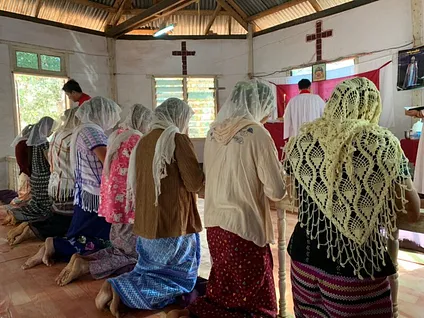
While this rule must be obeyed as it pertains to the fullness of the faith,when it comes to matters that Scripture has not spoken plainly on, and which cannot be clearly derived from natural law or the tradition of the Church, then we are free. And in that freedom, we truly and rightly celebrate the glorious diversity of the Church, encompassing a wide range of cultures and languages and ethnicities.. Perhaps the greatest example is styles of worship: while the Global Anglican Communion cleaves to a common liturgical standard in the Book of Common Prayer (1662) it also acknowledges that “it is not necessary that traditions and ceremonies be in all places one, and utterly like; for at all times they have been diverse, and may be changed according to the diversities of countries, times, and men’s manners, so that nothing be ordained against God’s Word.” 13 Therefore, we celebrate the proliferation of rites, musical styles, and expressions of spirituality throughout our Communion that are deeply enculturated, richly diverse, yet all rooted in a common liturgical source, common standard, and—most importantly—a common Lord toward whom they are oriented.
Seek the Mind of Christ
Article 12 concludes by stating that “we pledge to work together to seek the mind of Christ on issues that divide us.” This important statement acknowledges that there remains disagreement over primary matters within the Global Anglican Communion. We seek to approach this last part with great humility. The fullness of the faith is found in these primary matters; and while full adherence does not impinge on one’s salvation (Tier One), it does mean that we do not agree on what constitutes “orthodox faith and practice” (Tier Two). The disagreement this statement describes clearly does not relate to secondary matters, because we celebrate that diversity.Rather, this kind of disagreement threatens to divide us, for without agreement on primary matters there is no communion, there is no sharing of ministries, there is no fullness of the faith. We cannot and must not settle for “agreeing to disagree” about such matters, lest our own fellowship within the fullness of the faith be damaged or lost. The Jerusalem Declaration rightly pledges us to do the hard work of seeking unity on issues that divide us.
Before we address the specks in our brother’s eye (the Canterbury Communion), how do we remove the logs from our own (the Global Anglican Communion)? Article 12 points the way. We must seek “the mind of Christ,” which is found clearly in his self-revelation in the Holy Scriptures and the Natural Law, as evidenced by what the Church has believed and practiced “always, everywhere, and by all.” So come, let us turn to the Lord and seek his face; for wherever two or three are gathered together in his Name, he will grant their requests.
-
Article 11, Jerusalem Declaration ↩︎
-
Article 12, Jerusalem Declaration ↩︎
-
Article VI, The Articles of Religion. ↩︎
-
Catechism, 1662 Book of Common Prayer. ↩︎
-
Article XIX, The Articles of Religion. ↩︎
-
The Second Part of the Homily Concerning the Holy Ghost, For Whitsunday,Second Book of Homilies ↩︎
-
Article XIX, The Articles of Religion ↩︎
-
Canons of 1571, Canon 6 on Preaching: https://babel.hathitrust.org/cgi/pt?id=nnc1.cr59919094&seq=82, pg 82. ↩︎
-
Richard Hooker, Laws of Ecclesiastical Polity, V.8.2 ↩︎
-
1662 Book of Common Prayer, the Communion: “When the priest, standing before the table, hath so ordered the bread and wine… he shall say the prayer of consecration.” ↩︎
-
Article XXXVI, The Articles of Religion. ↩︎
-
It ought to be noted that “reason” in this sense predates the Cartesian revolution and Enlightenment. Therefore, it does not refer to a subjective interior thought process; but rather our participation—through the divine logos—in the rational order of the creation. Or in other words: natural revelation and natural law. It is an empirically objective faculty. ↩︎
-
Article XXXIV, The Articles of Religion ↩︎