Article 14. On the Second Advent of Christ
by Fr Matthew Brench
Article Fourteen
We rejoice at the prospect of Jesus’ coming again in glory, and while we await this final event of history, we praise him for the way he builds up his church through his Spirit by miraculously changing lives.
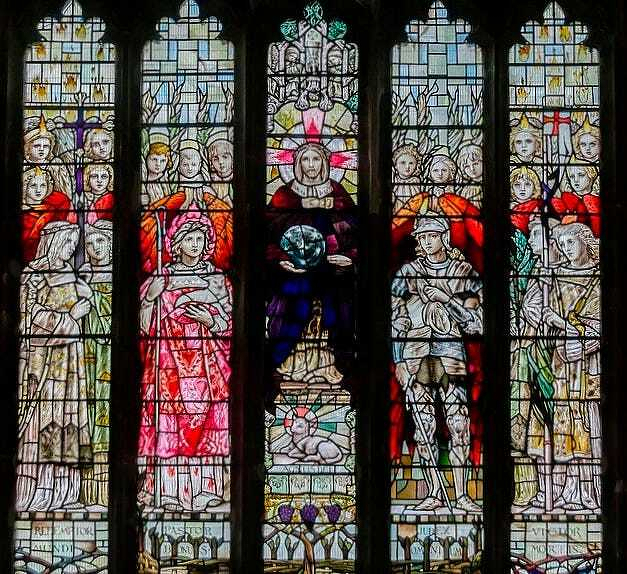
The Jerusalem Declaration ends where both the Bible and the Church Calendar end: in the eternal Kingdom of God. As the season of Advent both completes the lectionary’s annual round of Gospel teaching and begins the next, so too do our reflections on the “final event of history” spur us on to love and good works.
Understanding the Second Advent of Christ
“Why do you stand looking into heaven? This Jesus, who was taken up from you into heaven, will come in the same way as you saw him go into heaven” (Acts 1:11).
Easily misunderstood as a sort of divine abandonment, the doctrine of Christ’s ascension into heaven can rest uncomfortably on the tongue of many a well-meaning Christian reciting the Creed. That the Holy Spirit descended on the Day of Pentecost, as marvellous a gift as it was, can give one the feeling of a consolation prize. Many of our Lord’s parables speak of a master or landowner going away on a journey and then returning to his servants to check up on them and receive their due, but is that all there is to Christ’s ascension and eventual return, a test?
The Apostles’ initial feeling of abandonment was immediately salved by the angels’ words: “This Jesus… will come in the same way as you saw him go.” They did not need to stand looking into heaven, wondering what to do. Instead, it was time to get to work, prayerfully identifying and ordaining a new twelfth apostle until the Holy Spirit descended to direct and empower them to fulfill the Great Commission.
For the faithful in subsequent generations, the return of Christ remains an object of hope. Indeed, the Jerusalem Declaration’s 14th and final Article calls it a prospect at which we rejoice. This hope begins in Christ’s first advent and the Spirit moves us toward the second. So the good news of the incarnation that we celebrate at the beginning of the Church Year - the reconciliation of humanity with God in the God-Man, Jesus - finds deeper fulfillment in those who receive his Gospel, becoming themselves filled with the Holy Spirit. Far from experiencing divine abandonment, in this intervening period we have become possessions of God, as the Spirit himself makes us his Temple (1 Corinthians 6:19) until Christ is formed in us (Ephesians 3:17) and he returns to receive us unto himself. If that return is the culmination we await, the perfect wrap-up for all of God’s interaction with creation, the “final event in history,” then it must commence the eternal heavenly banquet, the wedding feast of the Lamb. And if that is so, then the Spirit’s descent in Pentecost and ongoing ministry in the Church to this day is not a mere consolation prize after a divine abandonment, but a dowry, a bridal shower, preceding the Big Day!
The second Advent of Christ also serves as a relief to those who have suffered unjustly for the name of Jesus. With the Psalmist the martyrs cry, “Return, O Lord! How long? Have pity on your servants” (Psalm 90:13)! Jesus warns us not to be deceived by promises of a hidden coming (Matthew 24:4-5, 23-27), promising instead that though he is hidden, seated at the right hand of the Father, on that day all the nations “will see the Son of Man coming on the clouds of heaven with power and great glory” (Matthew 24:30). For those who sleep in sin this day will come as an unwelcome surprise, as sudden destruction from which they will not escape (1 Thessalonians 5:3-4). He will appear in splendid, crimsoned apparel to tread the winepress of the fury of the wrath of God the Almighty (Isaiah 63:1, Revelation 19:15) and exact “vengeance on those who do not know God and on those who do not obey the gospel” (2 Thessalonians 1:8). After centuries of turmoil, strife, persecution, and crying out, “How long, O God, is the foe to scoff?” (Psalm 74:10), the Church will at last receive the relief of God’s perfect justice. In his first Advent Christ descended from the Mount of Olives, the people coming out to meet him on his way, as he advanced to Jerusalem for his Passion (Matthew 21:1-11). In his second Advent Christ will appear once again on the Mount of Olives (Zechariah 14:4) to be received as King by those citizens of the heavenly Jerusalem (Philippians 3:20, Hebrews 12:22) who will meet him in the air to join him as he descends (1 Thessalonians 4:13-17) to make the kingdoms of this world “the kingdom of our Lord and of his Christ” (Revelation 11:15).
Thus, while much language of judgment surrounds the doctrine of the Second Advent of Jesus, the Christian faithful need not fear. That Jesus who removed himself unto the right hand of the Father is the same Jesus who will return—the one whom we worship, serve, love, and adore is the one who will reunite himself with us, not only spiritually and sacramentally but also personally. As the resurrection of the body is the last stage in our salvation (reuniting our body and spirit), so too will Jesus’ return mark the last stage of the Church’s unification (reunited in body and spirit).
Awaiting the Second Advent of Christ
“Let both [wheat and weeds] grow together until the harvest, and at harvest time I will tell the reapers, ‘Gather the weeds first and bind them in bundles to be burned, but gather the wheat into my barn’” (Matthew 13:30).
Although the language of “awaiting” is prevalent, many iconic Scripture lessons of the season of Advent (Matthew 3:1-12, John 1:19-28, Romans 13:8-14, 15:1-13, 1 Corinthians 4:1-21) point us to a life of active anticipation. Waiting for the return of Christ may be better described as waiting upon the return of Christ, depicting us as his waiters, or servants, busying ourselves with all the good works that he has prepared for us to walk in.
But this is no servile labor, no hard burden or heavy yoke to bear, as if Jesus would have us trade our degrading enslavement to sin and death to an equally dehumanizing service to him (Isaiah 9:4, Matthew 11:30). Rather, our labor is one oriented towards hope—not because of personal ambition and anticipation of success—but because it is the Lord who builds and keeps watch (Psalm 127:1-2). Indeed, if we labor in the same direction as Christ, then we will find his yoke easy and his burden light, almost as if we weren’t working at all! This is not to say that the Christian has an exemption from effort, sweat, hardship, persecution, and suffering, but that we are freed from the crippling responsibility of being successful.
In our Lord’s Parable of the Wheat and the Weeds, an enemy seeds God’s field with a false crop that resembles the real wheat until it fails to produce the anticipated grain. At that point, it is too late to uproot the weeds without destroying the wheat, and so the Lord directs the servants not to destroy the weeds. Such judgment and vengeance remains in the hands of God and his sinless angels; we are freed from the responsibility of having to fix everything.
This stands in direct opposition to the spirit of the age, in which productive solutions are demanded for every issue that we face. Poverty must be solved, pollution must be undone, unjust systems must be dismantled and abolished; and surely we are called to labor and pray on behalf of the Kingdom in these and many other matters.1 Yet the doctrine of the Lord’s return, while enabling us to labor on his behalf in his physical absence, also informs us that the only true, effective, and permanent solution to the ills of this world is in Christ himself. As his servants we can minister his doctrine, discipline, and wisdom to the powers of a dark and sinful world, but until the end “you always have the poor with you, and whenever you want you can do good to them” (Mark 14:7). Freedom from perfectionism, from having to solve all the world’s problems ourselves once and for all, means we are able to serve according to our abilities and opportunities without losing hope; for our hope is in Christ our King who will come again to judge the living and the dead, and his kingdom will have no end.2
Celebrating the Second Advent of Christ
“Well done, good and faithful servant. You have been faithful over a little; I will set you over much. Enter into the joy of your master” (Matthew 25:21).
With the freedom that flows from the knowledge of the doctrine of Christ’s return, we are also, finally, in a position to celebrate. Knowing that Christ will return as the perfect eternal King of the cosmos, we rejoice. Anticipating that he will return to consummate his perfect kingdom, we praise him. Almost paradoxically, this fusion of divine providence and the doctrine of Christ’s return yields for us the ability to celebrate the “little things” all the more heartily. For while the Church knows she cannot redeem the world and solve every problem in every society, there remains unbridled joy in heaven over even one sinner who repents (Luke 15).
Thus the Jerusalem Declaration concludes, “we praise him for the way he builds up his church through his Spirit by miraculously changing lives.” For, while final redemption and salvation are beyond our human power to bring about, the Holy Spirit is indeed at work among us, and every little, local, personal advance in the Spirit is a victory to celebrate as it manifests the providence and wisdom of God and foretells his return. Every baptism is a new citizen welcomed into the kingdom of heaven; every confirmation and ordination is a new soldier enrolled in the Lord’s spiritual army; every burial of a faithful Christian is a spiritual graduation or birthday into the next phase of life; every eucharistic celebration is an hors d’oeuvres anticipating the Wedding Banquet. Every confession of sin and amendment of life is a battle front advanced against the enemy; every church planted is a new outpost of light established in a world of darkness; every personal spiritual breakthrough of knowledge or emotional maturity or spiritual insight is a testimony of the Spirit’s tireless work in our midst, preparing us and indeed the entire cosmos for the final and permanent appearance of Jesus.
It is our prayer that we all, members of the Global Anglican Communion or otherwise, will have the obedience and courage to accept the yoke of Christ, take up our cross, and thus be poised to celebrate his work through the Spirit in our midst both now and to eternity. As the mid-Advent collect puts it:
O Lord Jesus Christ, who at thy first coming didst send thy messenger to prepare the way before thee: Grant that the ministers and stewards of thy mysteries may likewise so prepare and make ready thy way, by turning the hearts of the disobedient to the wisdom of the just,
that at thy second coming to judge the world we may be found an acceptable people in thy sight. Amen.
-
For more on this topic, see Article 10 by the Rt. Rev Win Mott. ↩︎
-
This also stands in opposition to the accusations of some that the Church should remain a “mixed congregation” and that we must remain institutionally united at all costs, lest our schism do more damage than it intends to repair. See the previous Article for more on this. ↩︎