Article 6. Our Sacramental and Liturgical Heritage
“Lex orandi, lex credendi" (the law of what is prayed, the law of what is believed)
Article 6
We rejoice in our Anglican sacramental and liturgical heritage as an expression of the gospel, and we uphold the 1662 Book of Common Prayer as a true and authoritative standard of worship and prayer, to be translated and locally adapted for each culture.
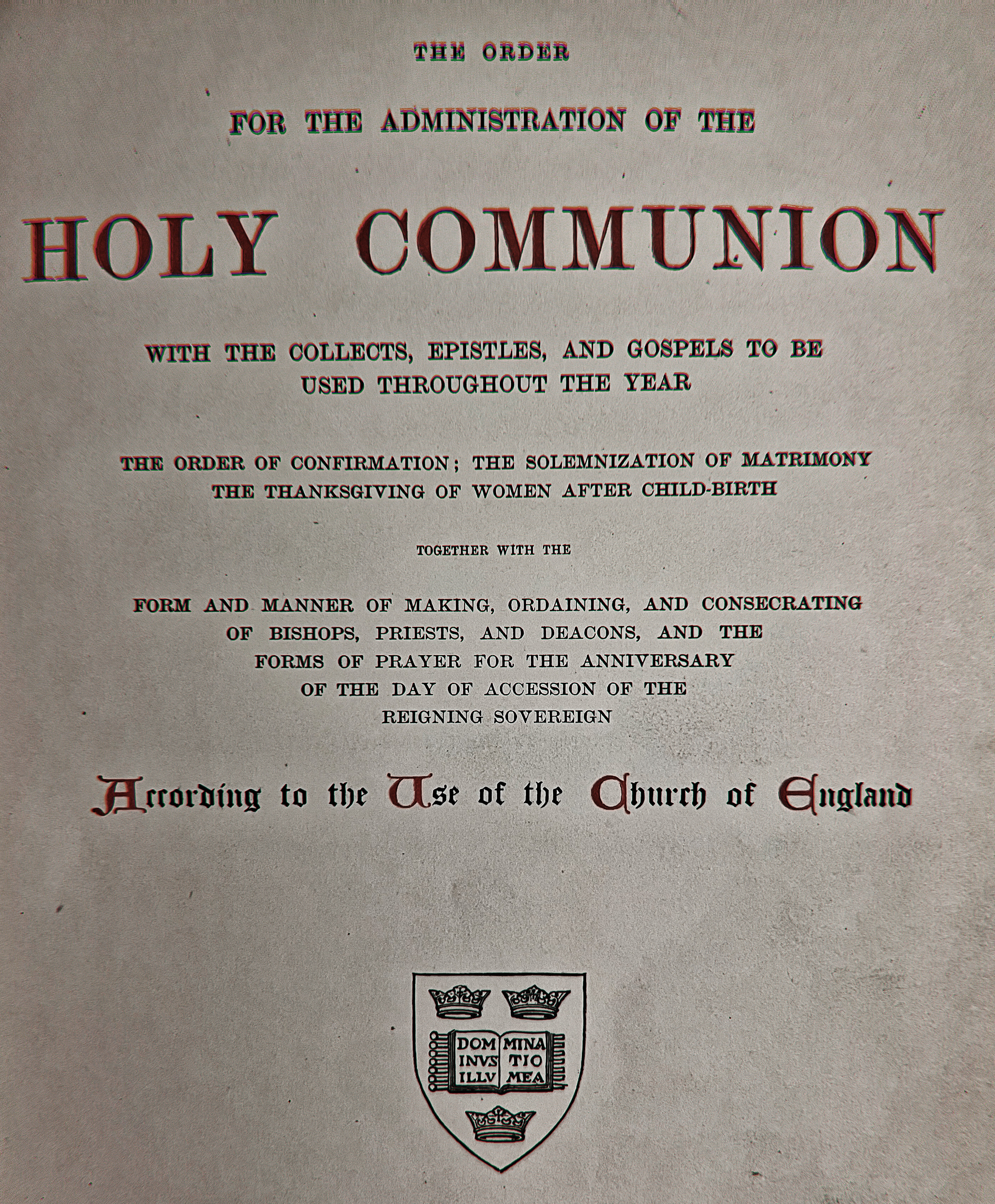
Most would agree that in the English world no other books have been as influential as the Authorized Version (or King James Version) of the Bible and the Book of Common Prayer (BCP).1 However, a careful reader picking up a first edition of either of these would not find an exact match to our contemporary editions. The Authorized Version underwent various spelling changes, an update in 1769, the later exclusion of the Deuterocanon in many circles, and the English text underwent major revision in the Revised Version (1894), Revised Standard Version (1957), then splintering into the New Revised Standard Version (1989) / NRSVue (2021), English Standard Version (2001), and Revised Standard Version 2nd Catholic Edition (2006). All maintain a common root—Holy Scripture—but each, including the Authorized Version, has a translation philosophy representative of the spirit of its given age, some with greater theological bias one way or another.2
The Book of Common Prayer serves in the English Spiritual Tradition as an apt analogy to the concerns of Bible translation. Is the worship of the church faithful to our origins? In what way? Formal equivalence? Dynamic Equivalence? Paraphrase? Do concerns of contemporary relevance, archaism, novel theology, or developing doctrine, change *what we do—*or rather, *who we are—*when we gather?
If Article VI of The 39 Articles of Religion is clear that all things necessary for salvation are contained in Holy Scripture, the Book of Common Prayer chronicles how the English tradition has read scripture: not in isolation, not individually, but corporately. These traditions integrating Word and Sacrament uphold the Apostolic faith. Indeed, the goal of the Book of Common Prayer as a project of the Reformation was that anything “contrary to Holy Scripture or to the ordering of the Primitive Church” was avoided because nothing should distract from the Gospel of God.3
Over the centuries, the Ecclesia Anglicana4 has undergone nearly as many changes as there are understandings of the word “Anglican” today. Nevertheless, we can look to the paths our church has traveled to understand and remember the way of the Anglican Spiritual Tradition.
“We rejoice in our Anglican sacramental and liturgical heritage as an expression of the gospel”
The Anglican tradition is a providential, radical experiment in expressing the simplicity of Gospel while participating in the unbroken pattern of apostolic sacramental practice, in continuity with the liturgical tradition of our forebears. Through the twists and turns of history—reformation, reaction, revolution, reconciliation (all in about 100 years from 1549-1662)—the Book of Common Prayer sought to uphold what was believed as the patristic faith expressed in the Church within the Western Tradition. What was of utmost concern was not finding ministry partners in the Reformation, or triangulating against Rome as such, but that the Gospel should be consistently proclaimed through the liturgy—both the proclamation of the Word and the sacraments—as a way to live out Holy Scripture through the tradition of the Church. The Gospel of God is that which cuts to the heart, and the liturgy must not distract from that.
The Book of Common Prayer is a tested public disclosure to the people and to the world of the lived, prayed, believed spirituality of the English Patrimony. The faith of the Church is disclosed by how she worships: not mere aesthetics, but prayer, and the sacraments upheld through these prayers.
As a standard, or Rule of faith
“we uphold the 1662 Book of Common Prayer as a true and authoritative standard of worship and prayer”
The 1662 Book of Common Prayer is more than any other the hard-won, authoritative, tested by centuries, bought with the blood of saints and martyrs, distilled core of reformed Catholicity:5 to add to it is to move in a direction (more Protestant, or more Catholic, or more liberal, etc.); to take away from it—to baldly contradict it—is removal of the Western Tradition itself, arguably the sacraments. Just as the liturgy is not to distract from the Gospel, so too should it represent valid sacraments. It should not misrepresent the sacraments as doing things they do not, nor misrepresent as not doing the things that they in fact do.
When a given strain within the tradition changes liturgy, its expression necessarily forms belief. If change is produced by looking to culture first and the tradition second, the beliefs that come from such liturgy may subvert the tradition itself by shaping downstream belief. Left unchecked, laity and clergy alike, shaped by the novel liturgy, may begin to expect as normal matters which contradict Articles VI, XXI, and the like, not the least other articles of the Jerusalem Declaration. That this has already happened in the Anglican tradition is reinforced by the existence of the Jerusalem Declaration itself.
The 1662 Book of Common Prayer as a standard represents the greatest unity of a church that is as Catholic (proclaiming the Gospel to all, in all places, at all times) as it is Reformed (which is to say, reforming from the abuses that distract from the Gospel). It represents a synthesis of at times conflicting sides of the church, who are as yet called by Christ himself to be one.
It means that if one conflicts, removes, or changes parts to it, one may deviate from the standard and thereby be at risk of changing the faith itself. While there are boundaries, this cannot be understood as rigid.6 Change may be good, even remedial. If we reject this, we would no longer be upholding the Reformation heritage our church expressed in Article XXI; that is, “even councils, may err, and sometimes have.” So too with Rites: “Wherefore things ordained by them as necessary to salvation have neither strength nor authority, unless it may be declared that they be taken out of holy Scripture.” The 1662 itself made a number of revisions to its predecessor prayer book—updating the language, clarifying the theology, and even adding liturgies that had become necessary due to the intervening history7—while insisting that these changes in no way represented a repudiation of the previous book, but rather stood in continuity with it.
However, the cost of revision must be counted soberly. John Henry Newman notes this in Tract III of Tracts for the Times, speaking of alterations in the liturgy,
If all your respective emendations are taken, the alterations in the Services will be extensive; and though each will gain something he wishes, he will lose more from those alterations which he did not wish.8
Revision to the liturgy, then, must not be undertaken lightly or triumphantly, but circumspectly.9 Fiddling with a standard changes all subsequent measurements. If one is converting a standard, it must be considered what consequences this may have if it is universally adopted in place of the former standard, the revision of which hazards removal of the worship of that local use from the worship of the church ‘always, everywhere, and by all.’10
Revision: Revolution, Evolution, Preservation
“to be translated and locally adapted for each culture.”
Translations
Returning to the idea of a biblical text: if the standard set forth in the English liturgy of the Western Tradition is a standard for contemporary as well as historic Anglicanism, and if the liturgy is not read directly (Hebrew or Greek, Latin or hieratic 17th-century English), then the manner in which the text is converted to the needs of the present day becomes important.
- Is the text a paraphrase or strongly dynamic translation: adapting shapes of the liturgy and repackaging phrases according to the translator’s priorities? (A)
- Is the text a formal—direct—translation: updating spelling and punctuation, names of monarchs, or removal of them, as applicable? (B)
- Or might it be a functional compromise or synthesis between the two? (C)
These three uses of the prayer book can be thought of as Revolutionary(A), Evolutionary(C), and Preservational(B). All must measure solidly against the authority of Scripture, under the authority of the church militant here on earth.
Revolutions
Article XX makes clear that the church has the authority to establish diverse rites, but they are only to be respected as liturgies of the Church insofar as they remain faithful to the biblical and apostolic deposit of faith. A liturgy, no matter how supposedly “authoritative” it may be, cannot carry any weight if it is “contrary to God’s Word written.” This precludes revolutionary texts which bear the authority of bishops who, or national conventions which,
-
Antagonize the plain meaning of scripture and the articles.
-
Subvert or supersede the Catholic deposit preserved in the classical Prayer Book.
Some, due to a theological conviction, have changed the liturgies in ways the classical Prayer Books did not envision, and the passage of decades of use renders normal a novel theology not found in the Prayer Book lineage.11 Whether trial liturgies or ratified Prayer Books, those which undermine the Gospel bear no authority in Christ’s church, though procedures of men have permitted them.
Some revisions are optimistically borne out of ecumenical tendencies, as exemplified by the ICEL-influenced liturgies,12 the aim not being English but universal in worship. These changes in rites owing to revolution of the modernism of the 20th century have benefits—again, of greater connection to other Christian bodies outside Anglicanism—but at the cost of rendering the already cloudy water of Anglican identity even more opaque.
This is not to say that such innovatory texts are not usable, much less invalid, but that when interpreting them, the intent and meaning must be assessed according to a standard that is not just the most recent committee which formed them. The classical Prayer Books—American, Canadian, English Editions—each have a consistency between them that is immediately familiar to a scholar of any one.
At best, therefore, these ecumenical projects may function as tangential traditions in relation to the Prayer Book Tradition; at worst, they exist in contradiction to it.
Evolutions
To guard against the risks of a revolutionary liturgical tradition, a more circumspect approach has been offered. An evolutionary text13 is by necessity a compromise or synthetic text: it is not directly participating in the standard but exists as a branch intentionally and repeatedly connecting to it. It aims to be a separate but complementary but not contradictory tradition leaning again on the authority of Article XX.
Such texts redirect the revolutionary liturgical period towards classical. In this it is not so much a syncretic work, but rather a synthetic: integrating the developments that most of the Western Tradition accept, while seeking to regain some of the English tradition14 that preceded the mid-20th century revolutionary tendency. It is one that is both a translation of the classical standard, and answerable to it, while also integrating another standard tradition, under the authority of its agreeableness with Holy Scripture and with churches across traditions. What is most important is that evolutionary worship nowhere conflicts with the standard given in the classical Prayer Book.
Preservations
A preservation liturgy maintains the provenance of the 1549-1662 Books of Common Prayer, including the 1928, 1962, and other national books which preceded the penchant for revolutionary revision. One example is the 1662: International Edition, an independent, non-ecclesiastical revision designed for use outside the Commonwealth,15 roughly aligning to Peter Toon’s philosophy of preservation: light updates, with local flourishes.16 Another is the Reformed Episcopal Church’s 2003 revision, which includes elements of the 1928 American and 1662 English traditions. Some, such as the ACNA 2019, allow options to preserve, in part, the classical book. In it there exists the option to re-arrange the Holy Communion into a 1662 shape,17 which, if used with the Prayer Book Society Canada’s 1662 supplement for Collects and Lections, retains the Western Tradition heritage of that service.18 The Reformed Episcopal Church continues to hold a classical prayer book lineage in its Book of Common Prayer revision in the Americas, UK, and Europe.
To follow the standard of the 1662 is to drink deeply from our Sacramental and Liturgical Heritage,19 of the last many centuries of providential stability, confidently rooted in the ancient traditions of the church and the priority of the Gospel. The Vincentian Canon calls the faithful to continue in worship that is recognizable as much 300 years ago as in the present, so that in 300 years it will still be recognizable. The guarantee of this is to carry the fire held by those before us and to pass it on undiminished.
Integrations
Whether using an old text preserved, or a new text authorized, we must uphold the classical Prayer Book tradition as a standard for Anglican Churches to maintain literacy, honor, and parity with the English expression of the Western Tradition we have received: we must never forget who we are, not relegating once-cornerstones to the scrap piles, but honoring and building upon them.
For more on the 1662 use across Global Anglicanism, please see my work, A Case for the 1662 Book of Common Prayer; or the Historic Lectionary preserved in the 1662 standard, On the use of the Historic Lectionary.
↩︎ (On the Jerusalem Declaration)
-
There are many ways this has been stated, among them, “After the Authorized (King James) Version of the Bible, the Book of Common Prayer is the most frequently cited book in the Oxford Dictionary of Quotations, and is one of the guiding influences on our language and the basis of religious expression in this nation.” https://www.pbs.org.uk/wp-content/uploads/2021/11/BCP.pdf ↩︎
-
For example: As was made famous with the RSV translating Isaiah 7:14, favoring the more recent Masoretic (young woman) over the Septuagint (virgin). This undermined the miraculous nature of the verse for modern readers, contrary to the interpretive decision Septuagint translators would have made 200 years before the Annunciation, when a virgin giving birth was just as implausible and unprecedented. In this case, a bias towards LXX translator’s decision, which communicates with greater accuracy the tradition of the church, corrects this, as in the Catholic Edition, so also with the ESV, another RSV derivative. Other biases should be approached with awareness and due caution, whether present in the custodian of the translation, or the translation text itself. ↩︎
-
Quoted from 2019 Preface, citing the 1549 preface, “It is more profitable, because here are left out many thynges, whereof some be untrue, some uncertein, some vain and supersticious: and is ordeyned nothyng to be read, but the very pure worde of God, the holy scriptures, or that whiche is evidently grounded upon the same; and that in suche a language and ordre, as is moste easy and plain for the understandyng, bothe of the readers and hearers.” ↩︎
-
The English Church, a phrase in use since the 13th century. ↩︎
-
“The Prayer Book services must be interpreted in accordance with general or Catholic practice, and not according to new ideas of the sixteenth century, whether the innovations of foreign reformers or the legislation of the Council of Trent.” Francis C. Eeles, “The Rite of 1662 Re-Examined.” Thoughts on the Shape of the Liturgy. XXIV. Alcuin Club Tracts (1946). ↩︎
-
“In 1685, a clergyman named Sparkes was prosecuted in the Court of King’s Bench for using “other prayers in the Church and in other manner “than those provided in the Prayer Book. He was acquitted on the ground that he had used “other forms and prayers” not instead of those enjoined, but in addition to them. S.S.C. therefore was introducing no innovation when it turned its eyes elsewhere for guidance in those matters which the Prayer Book omitted, but nowhere prohibited.” J. Embry, “The Catholic Movement and the Society of the Holy Cross” (1931) ↩︎
-
“In that Preface to the Prayer Book which was written by Bishop Sanderson in 1661, it is stated that among other alterations and additions it was thought expedient to add “an Office for the Baptism of such as are of riper years; which, although not so necessary when the former Book was compiled, yet by the growth of Anabaptism, through the licentiousness of the late times crept in amongst us, is now become necessary” John Henry Blunt, The Annotated Book of Common Prayer. Revised and Enlarged Edition (1889). ↩︎
-
https://en.wikisource.org/wiki/Tracts_for_the_Times/Tract_3 ↩︎
-
“Already [1963] our liturgy is one of the very few remaining elements of unity in our hideously divided Church.” C. S. Lewis, Letters to Malcolm (1963), p.6.
“By the way, that’s another thing to be avoided in a revised Prayer Book. ‘Contemporary problems’ may claim an undue share. And the more ‘up to date’ the book is, the sooner it will be dated.” C. S. Lewis, Letters to Malcolm (1963), p.12. ↩︎ -
This is a paraphrase of the Vincentian Canon, an aphorism of the Catholic faith: “in the Catholic Church itself, all possible care must be taken, that we hold that faith which has been believed everywhere, always, by all. For that is truly and in the strictest sense Catholic, which, as the name itself and the reason of the thing declare, comprehends all universally. This rule we shall observe if we follow universality, antiquity, consent.” Commonitorium of Vincent of Lérins, chapter 2 (c. 434), https://www.newadvent.org/fathers/3506.htm ↩︎
-
For more on this, refer to the writings of Peter Toon, especially during his tenure at the Prayer Book Society USA. https://newscriptorium.com/toon-about.html ↩︎
-
International Commission on English in the Liturgy, the Roman authority on English translations of their own Latin texts. Eucharistic Prayer A from BCP 1979 is an example of an ICEL prayer implemented from Roman into Anglican use, having no precedent in the Prayer Book tradition. cf, M.J. Hatchett, Commentary on the American Prayer Book (1980), p. 634. Related to ICEL is the International Consultation on English Texts, an ecumenical group supporting agreed English language in the liturgy separate from traditional Anglican phrasing. ↩︎
-
The 2019 BCP self-identifies as an Evolutionary text, cf., What is the ‘Yolk’ of the Anglican Church in North America’s Book Of Common Prayer 2019 ↩︎
-
The Anglican Missal might serve as either an example of evolutionary integration or of preservation. It reclaims and integrates the Medieval practice into the Prayer Book tradition, which most would assent to Cranmer’s project being a revolutionary one. Alternatively, The Missal may be a remedial foil against contemporary, revolutionary Liturgical Movement changes to the Western pattern of liturgy. ↩︎
-
A New Global Edition of the Classical 1662 Book of Common Prayer ↩︎
-
“Now for use in the USA there will need to be a little editing of The BCP 1662 for the Monarch is very much part of this Prayer Book, but this can easily be achieved, and prayer for Presidents and Governors and the like introduced.” Peter Toon, Why is The BCP 1662 so popular all of a sudden; and why is its American child, The BCP (1928), in continuing if slow demise? ↩︎
-
“Indeed, in all of catholicism in the twenty-first century, Anglicanism alone preserves the one-year Eucharistic lectionary that had been fully developed by the church by the seventh century.” Gary Thorne, Robert Crouse and Prayer Book Catholicism ↩︎
-
“The original idea of the men of the Oxford Movement was to obey the Prayer Book and its rubrics, and to treat the rite as being itself within what is called the Catholic tradition.” Francis C. Eeles, “The Rite of 1662 Re-Examined.” Thoughts on the Shape of the Liturgy. XXIV. Alcuin Club Tracts (1946). ↩︎