Article 8. On Theological Anthropology and Holy Matrimony
By The Rev. Canon Jay Thomas and Mrs. Emelie Thomas
Article 8
We acknowledge God’s creation of humankind as male and female and the unchangeable standard of Christian marriage between one man and one woman as the proper place for sexual intimacy and the basis of the family. We repent of our failures to maintain this standard and call for a renewed commitment to lifelong fidelity in marriage and abstinence for those who are not married.
From Creation
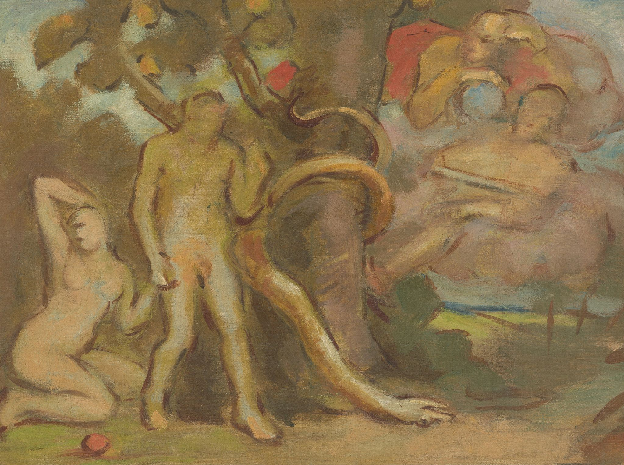
Humanity is the crown of God’s creation. God prepares his created world, proclaiming “good” after “good”, and then fashions his very image and likeness at the culmination of his creation, declaring: “Let us make man in our image, after our likeness” (Genesis 1:26a). God participates intimately with mankind from the very beginning—breathing into man, breaking and molding flesh from flesh, and ordaining mankind to bear his image. This participation in God’s image is one of unity and diversity: “So God created man in his own image, in the image of God he created him; male and female he created them” (Genesis 1:27). Within man—humanity—God creates two kinds: male and female. Having created and appointed them stewards of his work, God regards everything he has made and declares that it is “very good” (Genesis 1:31).
From the outset, this communion between male and female in humanity is ordained for partnership: “The LORD God said, ‘It is not good that the man should be alone; I will make a helper fit for him” (Genesis 2:18). “Fittingness” between man and woman is a thread that is deeply woven into God’s design for humanity. God designs a partnership between men and women that centers each sex’s uniqueness in a common good, where the two sexes' strengths and weaknesses, proclivities and pitfalls receive and require the support of the other. The “fittingness” of man and woman is fundamental to marriage, where, within the context of lifelong partnership, unity-in-diversity finds its symbolic fulfillment in sexual intercourse where man and woman physically fit together as one flesh.
This one-flesh union is a signpost for humanity’s ultimate fulfillment: the union of flesh and the divine. The fulfillment of humanity lies not in the creation and joining of man and woman, but in the incarnation of the creator himself, where God joins himself to mankind that we might dwell in him as he dwells in us.
And because “the Word became flesh and dwelt among us” (John 1:14) and has now—in his human flesh—been seated on the throne of heaven (Revelation 3:21), what we say about humanity has theological implications. Indeed, anthropology is necessarily Christological. If we are to rightly understand God, we must rightly understand the fleshly humanity that not only bears the imprint of the divine image but also has been assumed into the Godhead through Jesus Christ.1
Therefore, the manner in which God creates humanity—male and female—must be held as a sacred ontological gift. We cannot treat this aspect of creation as arbitrary or lapsarian. Rather, we must recognize that its fundamental “fittingness” is given in the providence of God.
Unchangeable Standard
While not everyone is called to marriage,2 the union of man and woman in holy Matrimony images a closeness of communion that God intends for all people, in him. Marriage serves as an icon of the union between Christ and his Bride: “This mystery [of marriage] is profound, and I am saying that it refers to Christ and the Church” (Ephesians 5:32). We should note that the “mystery” Paul refers to is “sacramentum” in the Latin translation of the Bible. Our English reformers likewise instruct us to view marriage through the lens of sacramental theology.3 In a sacrament, God houses a mystery, using created matter as the means and instrument through which his invisible and spiritual grace is poured out upon us. In marriage, that invisible grace and reality is that “the two become one flesh” (Genesis 2:24)4 as a cosmic image of the one-flesh union between God and his people.
Therefore, marital union does not exist for itself. Just as the union between Christ and the Church propagates the Gospel and brings forth new life in faith, so too the marital union of man and woman is firstly ordained for the propagation of humanity and the creation of new life.5 “God blessed them and said, ‘Be fruitful and multiply’” (Genesis 1:28). The spiritual and sacramental reality marriage evokes is never sterile, so human marriage must never be ordered toward sterility. This does not mean that a man and woman who face unchosen infertility are married contrary to the will of God. But it does mean that marriage is, by definition, the kind of union that brings life into being, because marriage is ontologically ordered toward procreation.
For this reason, above all others, the Church cannot bless sexual relationships between those of the same sex; they are sterile—not incidentally, but definitionally. Therefore, they are ontologically unable to participate in the sacramental union intended by God. These same-sex relationships take the “fittingness” of humanity—which is borne out physically in the sacramental one-flesh union—and ignore it. This negligence is, in essence, a rejection of God’s good created order. This is why Paul says that such unions have “exchanged the truth about God for a lie and worshiped and served the creature rather than the Creator” (Romans 1:25-27). The truth about God is that he made man, male and female, in his image and likeness, and then joined himself to that likeness. To depart from God’s fitting intentions is to blaspheme the very creator who participates in his creation. It is, the apostle says, an expression of idolatry.6 Therefore, those who do not repent of this act of blasphemous self-worship “will not inherit the kingdom of God” (1 Corinthians 6:9).
And yet, Paul does not relegate just those in same-sex relationships to this condemnation; all who engage in any sort of sexual immorality are condemned in the very same verse. What is sexual immorality? It is using God’s intended sign of one-flesh union in a way that undermines its sacramental, consummational, and covenantal meaning.7 This is why sexual intimacy is so charged and fraught—it joins two humans in a union of cosmic and spiritual scope. Paul notes that this one-flesh union is consummated not just by those in a marriage, but even between a prostitute and client (1 Corinthians 6:15-20). Through our union with Christ, our bodies have been made temples of the Holy Spirit, but when we subject that temple to any form of sexual immorality, the sacred is profaned, and the creator is blasphemed.
Repentance and Renewed Commitment
As a Church we have failed to consistently uphold God’s mystical intentions—both for this one-flesh union of marriage and for the intrinsic goodness and givenness of God’s creation of male and female as distinct, yet wonderfully made. We repent. Before regarding the sins of others, we must repent of our own sins.
-
We have not taken seriously enough our Lord’s admonition that “What God has joined together let not man separate…[Therefore], whoever divorces his wife, except for sexual immorality, and marries another, commits adultery” (Matthew 19:6, 9). For this we repent.
-
We have not catechized the faithful in the true goods and purposes of marriage enumerated in Scripture and the Prayer Book. Instead, we have succumbed to the world’s understanding of marriage as a loving contract between two consensual parties, rather than as an icon of the ever self-giving one-flesh union between Christ and his Church. For this we repent.
-
We have focused on same-sex-attracted identity and treated such attractions as more inherently sinful than other temptations to sin rather than catechizing the Church and the world on God’s good and loving purposes for marriage and all humanity—a vocation into which he beckons all of creation. For this we repent.
-
We have not upheld the single and celibate life as an inherently godly calling, in which true fulfillment of our humanity is possible through union with Christ in the community of his church. Instead, we have treated Christian marriage as a source of human fulfillment, and honored it above other estates of life as a mark of Christian maturity. For this we repent.
-
We have not done enough to listen to and love those struggling to accept the goodness of God’s creation of them as male or female. For this we repent.
Out of repentance, God brings forth new life. Thus, we renew our commitment to God’s good creation of humanity as male and female, hallowed in his incarnation. And we renew our commitment to proclaiming the mystical union of marriage first and foremost as an icon of Christ’s union with his Church and as a means for participating in the cosmic work of his redemption.
-
“The Athanasian Creed*”*, Book of Common Prayer (2019) pg. 771: “Who, although he be God and Man, yet he is not two, but one Christ; One, not by conversion of the Godhead into flesh, but by taking of the Manhood into God.” ↩︎
-
See 1 Corinthians 7:25-28 ↩︎
-
See “The Homily on Swearing and Perjury” in The Book of Homilies. ↩︎
-
This verse is central to the New Testament’s thinking about marriage. It is quoted in Matthew 19:5; Mark 10:8; 1 Corinthians 6:16; and Ephesians 5:31. ↩︎
-
“Holy Matrimony [was] first…ordained for the procreation of children.” in “The Solemnization of Matrimony” The Book of Common Prayer (1662). ↩︎
-
Romans 1:22-23 ↩︎
-
Such a distortion of sexuality’s purpose and meaning can even happen within marriage, as for example when the husband or wife (or both) treat the other as an object rather than a person, or approach sex primarily as a source of self-satisfaction rather than self-gift. ↩︎