The Necessity of Ecclesial Discipline
Supplemental Essay on Article 7: On the Historic Succession and Ministry
by the Ven. Andrew Brashier
Faithfulness in All Things
The Necessity of Ecclesial Discipline
My previous supplemental essay1 argued for the necessity of the Global Anglican Communion to uphold its professed standards regarding male-only holy orders. While the restoration of the Apostolic and Catholic practice of ordaining only men is needful, we should beware of succumbing to tunnel vision and thereby think that if this were remedied the Communion would be of sound health. Ordaining men in succession who teach apostolic doctrine, while necessary, is not sufficient to the fulfillment of the calling laid upon the ministers of Christ’s Church. Undoubtedly, as the Articles state, in “the visible Church the evil be ever mingled with the good, and sometime the evil have chief authority in the ministration of the word and sacraments.”2 This tragic and sinful reality is not something we should merely wring our hands and lament as a reality this side of Eden. Rather, when ministers fail, they should be disciplined. When ministers are disqualified, they should be removed. When a postulant is unqualified, hands should not be laid upon him. Therefore, “it appertaineth to the discipline of the Church that inquiry be made of evil ministers, and that they be accused by those that have knowledge of their offences; and finally, being found guilty by just judgement, be deposed.”3 Hence, the English Reformers held:
“The true Church is an universal congregation or fellowship of God’s faithful and elect people, built upon the foundation of the Apostles and Prophets, Jesus Christ himself being the head corner stone. And it hath always three notes or marks, whereby it is known; pure and sound doctrine, the Sacraments ministered according to Christ’s holy institution, and the right use of ecclesiastical discipline. This description of the Church is agreeable both to the Scriptures of God and also to the doctrine of the ancient fathers, so that none may justly find fault therewith.”4
We would do well to remember that the renewal of the English Church was centered not only on the reform of doctrine but of character. Far removed from the afflictions and oppressions experienced by the Church in the Apostolic and Patristic ages, the medieval Church grew lax in her discipline. The failure to discipline scandalous and erring clergy, especially bishops, led in part to the Reformation. The homilist explains, “Now, if ye will compare this with the Church of Rome, not as it was at the beginning, but as it is presently and hath been for the space of nine hundred years and odd, you shall well perceive the state thereof to be so far wide from the nature of the true Church, that nothing can be more.”5
What precisely is at risk? The flock for whom Christ shed his precious blood. When the leadership of the Church fails the core concern is not the protection of the institution or the threat of earthly litigation. Every man before being ordained a priest is enjoined to
“have always therefore printed in your remembrance how great a treasure is committed to your charge. The Church and congregation whom you must serve, is his spouse and his body. And if it shall happen the same Church, or any member thereof to take any hurt or hindrance by reason of your negligence; ye know the greatness of the fault and also the horrible punishment that will ensue.”6
The failure of a minister, either in doctrine or in deed, puts the souls of the faithful at risk. How many souls will never enter a church again because of the failure of a minister? How often must Christ’s name be taken in vain because the leadership of the Church fails to discipline her ministers in accord with her own standards?
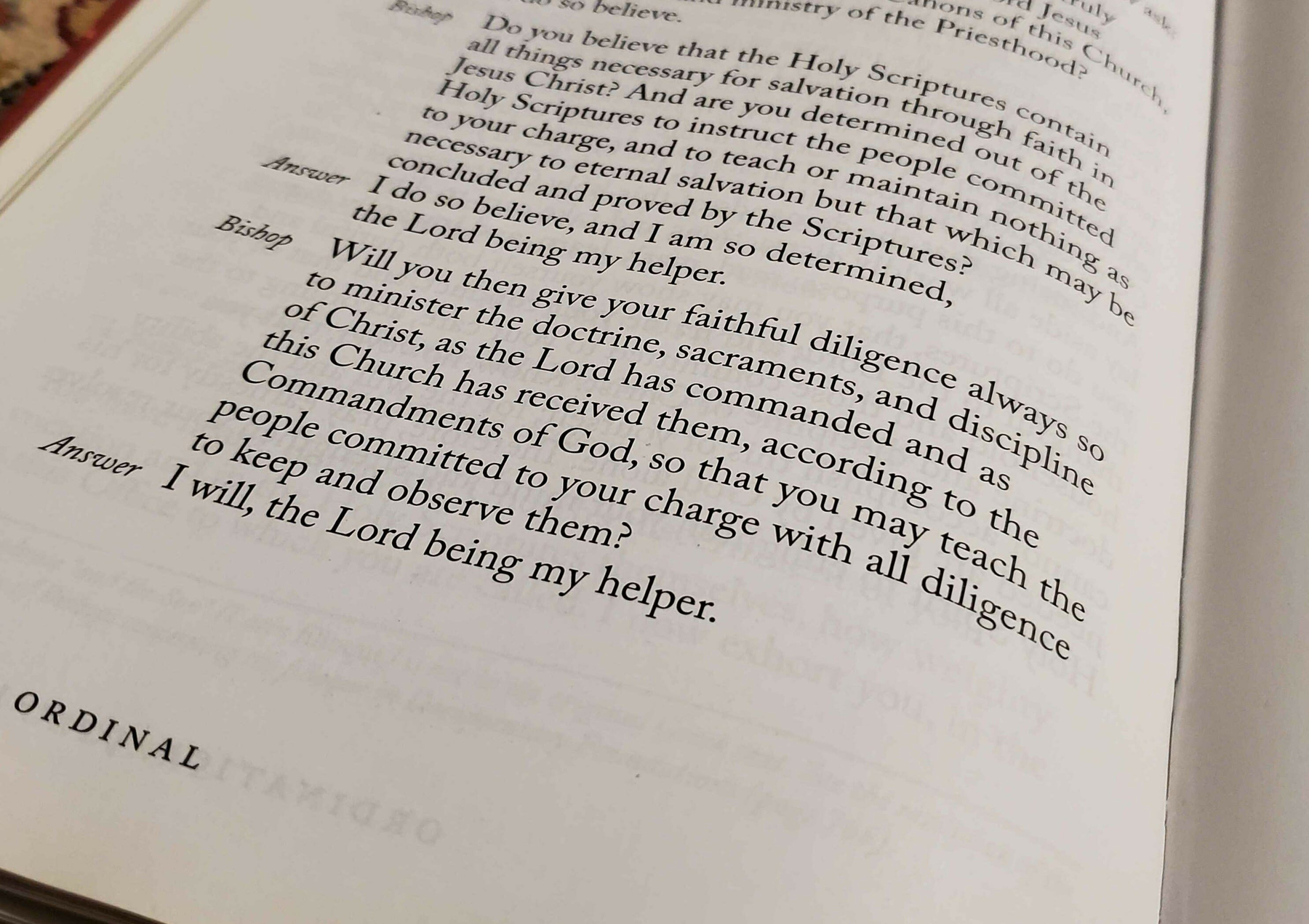
We have a standard in the Ordinal, and it commands oaths, duties, commitments, requirements, and expectations to protect the flock. We must use the Ordinal to hold candidates and ministers accountable in meeting the high standards and measures in God’s holy Word. Cranmer wrote the Ordinal’s Preface in an era where immoral, unformed, unlearned, and unqualified clergy were rampant. Yet he did not alter nor lessen Scripture’s requirements; instead, he endeavored to raise, discern, and uplift qualified and godly men into the ministry. Cranmer laments in part and lays out his vision, stating “Which offices [Bishops, Priests, and Deacons] were evermore had in such reverend estimation that no man might presume to execute any of them except he were first called, tried, examined, and known to have such qualities as are requisite for the same, and also by public prayer with imposition of hands were approved and admitted thereunto by lawful authority.”7
Therefore, it is imperative for the Global Anglican Communion’s member-provinces, dioceses, and parishes to examine, reexamine, and reform their structures to ensure that ecclesiastical discipline and justice are maintained. Furthermore, to avoid the errors of the Canterbury Communion, Global Anglicans must establish accountability between member provinces to ensure the faith is maintained and erring provinces are called to repentance, with appropriate consequences should a province remain unrepentant. Anathemas and excommunication are not remedies to be used lightly, but they are necessary to protect the faithful while publicly refuting error, heresy, and sin as needed.
An Authority with Accountability – Forming Godly Clergy
The Ordinal is our rubric and syllabus in forming future clergy and the flocks they will soon serve. As the Global Anglican Communion is reformed and reordered, it does us a disservice not to examine our clergy and hold them accountable to the bishop’s examination for each office within the Ordinal:
- Do our clergy “unfeignedly believe all the canonical Scriptures of the Old and New Testament?”
- Do they “instruct the youth in the catechism?”
- Do they “search for the sick, poor, and destitute people of the parish … that they may be relieved with the alms of the parishioners or others?”
- Do they “apply all … diligence to frame and fashion [their] own lives, and the lives of [their] families, according to the doctrine of Christ; and to make both [themselves and their families], as much as in [them] lieth, wholesome examples of the flock of Christ?”
Each of these standards derives from the Ordering of Deacons, and because every priest and bishop is first a deacon, it behooves us as a Church to remember these high standards and prayerfully require them of all our clergy. Likewise, re-reading and holding our priests and bishops accountable to the oaths and commitments in the Ordinal’s rites for ordering priests and consecrating bishops must be taken up once again.
The Ordinal is our best method to measure “those we ought to judge lawfully called and sent.”8 Defying the Ordinal’s requirements dangerously treads beyond the bounds of Scripture and the gates of catholic tradition, thereby threatening the faithful proclamation of the true Gospel, the right administration of the Sacraments, the historic apostolic succession of holy orders, and the safeguarding of the flock of Christ in His doctrine. Let us take up and apply the Scripture-saturated Ordinal in determining, measuring, and confirming those “rightly, orderly, and lawfully” called to the diaconate, presbyterate, and episcopate.9
Likewise, the Global Anglican Communion must use this opportunity to form and create governing structures that not only keep member provinces accountable to one another under the professed standard of the Jerusalem Declaration but also to ensure the entire Church participates in governing. To this end, I encourage those Bishops meeting in council in Abuja to humbly consider such ecclesial structures already in existence, like the Cairo Covenant of the Global South Fellowship of Anglicans. Accountability is not limited to the clergy keeping each other in check, but is a mission and calling of the entire Church. Recall our Lord’s words in Matthew 18:17, “If he refuses to listen to them, tell it to the church.” The laity must be empowered to govern and to hold clergy and laity alike accountable. Listen to the words of St. Paul, which were not to bishops, presbyters, and deacons but to the entire Church of Corinth:
“Or do you not know that the saints will judge the world? And if the world is to be judged by you, are you incompetent to try trivial cases? Do you not know that we are to judge angels? How much more, then, matters pertaining to this life!”
(1 Corinthians 6:2-3).
Our Lord provided His Spirit-filled Holy Word for us to follow; therefore, let us take up and hear, read, mark, learn, and inwardly digest Almighty God’s requirements for the ministry and men He calls, for pride goeth before the fall. Let us invite the whole church, laity and clergy alike, to work together because the Church does not consist of only clerics but the entire people of God gathered together. The English Reformers rightly objected to cleric-only masses and forbidding the cup to the laity; how much more should we object to governing institutions that lack representing the full body of Christ, His Church? Henceforth, let us not pride ourselves on our orthodoxy, but prayerfully engage in the hard work of orthopraxy.
-
Andrew Brashier, “Women’s Orders and the Ordinal”: https://commentary.anglican.center/supplement-jd7-womens-ordination-and-the-ordinal/ ↩︎
-
Article XXVI, Articles of Religion ↩︎
-
Ibid. ↩︎
-
The Second Part of the Homily Concerning the Holy Ghost, For Whitsunday, Second Book of Homilies ↩︎
-
Ibid. ↩︎
-
The Form and Manner of Ordering of Priests, The Ordinal, 1662 BCP ↩︎
-
Preface, The Ordinal, 1662 BCP ↩︎
-
Article XXIII, Articles of Religion ↩︎
-
Article XXXVI, Articles of Religion ↩︎